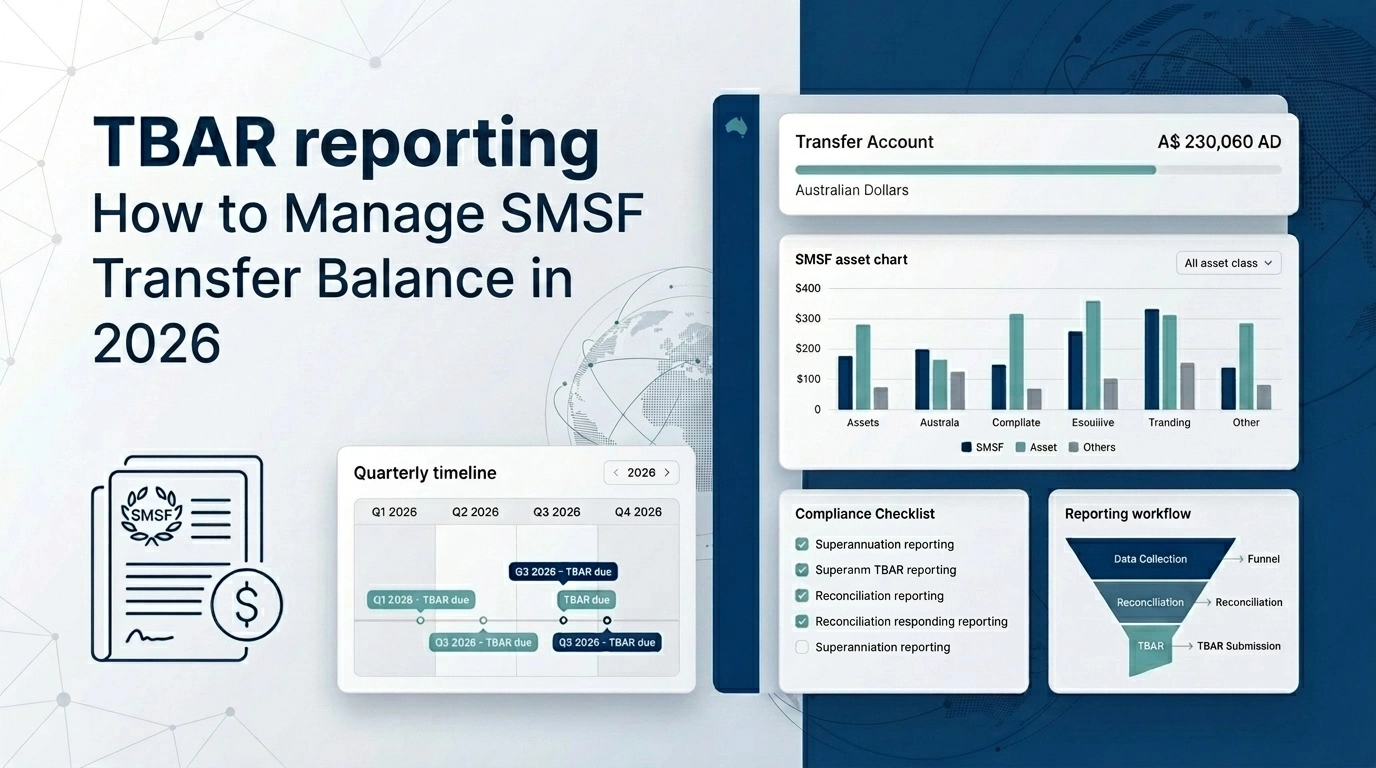
TBAR reporting is the way an SMSF reports certain pension and transfer balance events to the ATO. In 2026, that means when a reportable event happens, it generally needs to be reported on a quarterly basis, with the lodgement due 28 days after the end of the relevant quarter. In simple terms, if a member starts, changes, or commutes a retirement phase pension, your team may need to act much earlier than it did under the old annual concession.
This matters right now because the annual TBAR concession has ended on 1 January 2026. For SMSF professionals, accountants, and bookkeepers, that changes the rhythm of the work. You cannot rely on a year-end catch-up anymore. You need cleaner data flow, faster trustee communication, and a process that picks up reportable events before the quarter slips away. Founder to founder, this is where good firms can still get caught.
This guide covers what changed in 2026, which events trigger TBAR reporting, the due dates to watch, the mistakes that cause rework, the software features that make the job easier, and the practical process steps that help accountants and bookkeepers stay compliant without adding unnecessary stress.
2026: The Quarterly TBAR Reporting Shift is Here
From 1 January 2026, the ATO requires all SMSFs to report transfer balance account events quarterly. The old annual concession is no longer available. If a reportable event occurs during the quarter, the TBAR is generally due 28 days after quarter-end.
For example, if a member starts an account-based pension on 10 February 2026, that event falls into the March quarter and is due by 28 April 2026. You cannot leave it until the annual return.
Why does this matter in practice? Because quarterly TBAR work depends on speed. Your team needs timely trustee updates, current processing, and a clear review point before each deadline. In reality, this is where even well-organised firms feel the pressure.
What this means for your practice:
- Capture pension events earlier
- Reconcile throughout the year
- Review before each deadline
- Tighten trustee communication
- Assign clear ownership
The technical point is simple. If there is no reportable event, there is generally no nil TBAR. If there is a reportable event, the quarter-end deadline applies.
TBAR Reporting Rules and Deadlines
TBAR reporting is event-based. You do not lodge just because a quarter ended. You lodge a reportable event because a reportable event changed a member’s transfer balance account in that quarter.
For example, if a member commutes part of a retirement phase pension in May 2026, the due date is
28 July 2026. If the paperwork sits too long, the issue is not tax knowledge. It is a process delay.
That is why firms need an internal review point before the ATO due date. Check the event type, date, support, and software treatment early.
2026 TBAR Reporting Due Dates
Put these dates in your team calendar now:
- 28 April 2026: Events between 1 January and 31 March
- 28 July 2026: Events between 1 April and 30 June
- 28 October 2026: Events between 1 July and 30 September
- 28 January 2027: Events between 1 October and 31 December.
These dates shape staffing, review timing, and trustee follow-up.
A practical way to work this:
- Set an internal review date before each ATO deadline
- Check for pension starts, commutations, and death benefit events
- Verify coding inside Class or BGL
- Confirm support before lodgement
- Escalate anything unclear early
A missed deadline can trigger Failure to Lodge penalties and leave the member’s transfer balance account out of step with the ATO record.
What Counts as a TBAR Event?
Not every SMSF transaction belongs in a TBAR. Report the right event, value, and date.
A common example is a pension commencement. The start of the pension is the TBAR event. Regular pension payments after that are generally not separate TBAR events.
Common reportable events include:
- Pension commencements
- Lump sum commutations
- Death benefit income streams
- Certain compliance-driven changes
The ATO record affects the member’s transfer balance position. The general transfer balance cap also increased to $2 million from 1 July 2025, while each member’s personal cap can still differ.
For the current rules, use the official ATO TBAR reporting guidelines.
Easy trap to avoid: routine pension payments are usually not separate TBAR events.
Why Your TBAR Reporting Setup Matters Most
Most TBAR problems do not start with the law. They start with the workflow.
You can know the rules and still miss a deadline if trustee updates come in late, coding is inconsistent, or no one owns the final review.
A stronger setup usually includes:
- Current bank feeds
- Clear trustee instructions
- Configured software workflows
- Quarterly review checkpoints
- Clear ownership
If a trustee tells you in March that a pension started in January, the file becomes rushed. Earlier checks make the same job manageable.
A better setup gives you:
- Earlier event capture
- Lower correction risk
- Cleaner support files
- Less review pressure
At BlueCrest, we help firms strengthen their SMSF services by handling the repeatable back-end work that tends to clog up internal teams, especially transaction processing and reconciliations. We also support practices that need extra depth in SMSF accounting support when quarter-end compliance pressure starts to build. That gives reviewers cleaner files and more time to focus on technical judgment instead of admin follow-up.
The key point is simple. Good TBAR reporting depends on event capture, review timing, and ownership.
Class vs BGL: Which TBAR Workflow Helps More?
Most firms already use either Class or BGL Simple Fund 360. Both can support SMSF Tbar reporting, but the workflow differences matter when volume rises.
| Feature | Class Super TBAR Console | BGL Simple Fund 360 TBAR |
| Event Identification | Auto-detects processed events | Real-time alerts |
| Bulk Lodgement | Bulk lodgement across funds | Dashboard-based tracking |
| Error Checking | Pre-lodgement validation | Validation and status tracking |
| Correction Workflow | Cancel and replace workflow | Detailed audit logs |
What matters most depends on your bottleneck:
- Bulk lodgement helps high-volume teams
- Validation and status tracking help reduce rework
- Audit trails help when corrections are common
If your firm is still weighing the two platforms, our detailed comparison of Class Super vs BGL 360 goes deeper into the workflow differences.
Common TBAR Reporting Examples and Fixes
Small TBAR mistakes can flow through to the member’s transfer balance account.
If John starts an account-based pension on 15 February 2026 with $1.5 million, the TBAR is due by 28 April 2026.
If that event was lodged as $1.6 million instead, the usual fix is to cancel the wrong event and lodge the correct one.
When fixing errors, check:
- Event type
- Effective date
- Reported value
- Software reference
- ATO processing status
Outsourcing TBAR Reporting for SMSFs
Many firms do not struggle with TBAR because of the rules. They struggle because the work is spread across processing, follow-up, review, and lodgement.
At BlueCrest, we help practices identify reportable events during normal reconciliation and processing so local reviewers can focus on sign-off and client communication.
The practical benefits are clear:
- Earlier deadline control
- Stronger data integrity
- Better capacity during busy periods
- Cleaner review files
If your firm is reviewing ways to streamline delivery, our SMSF administration services can be built into the workflow you already use rather than forcing your team into a whole new system. For firms that also need help getting year-end files ready around quarterly compliance touchpoints, our support for SMSF accounting can slot into the same delivery flow.
Ready to Tighten the Process? Here’s What to Do Next
If TBAR reporting keeps creating follow-ups, rushed reviews, and deadline pressure, the issue is usually the process behind the form.
At BlueCrest Accounting Solutions, we support the back-end SMSF work that helps surface reportable events earlier and hand over cleaner, review-ready files.
What we help with:
- Transaction processing and reconciliation
- Quarter-end monitoring
- Workpaper support
- Review-ready output
- Scalable delivery capacity
What to do next
Review your current TBAR workflow. Check how events are picked up, who reviews them, what support is held, and when lodgement decisions are made.
If your team needs extra capacity or cleaner quarter-end support, Contact BlueCrest today, and we can walk through your workflow with you.