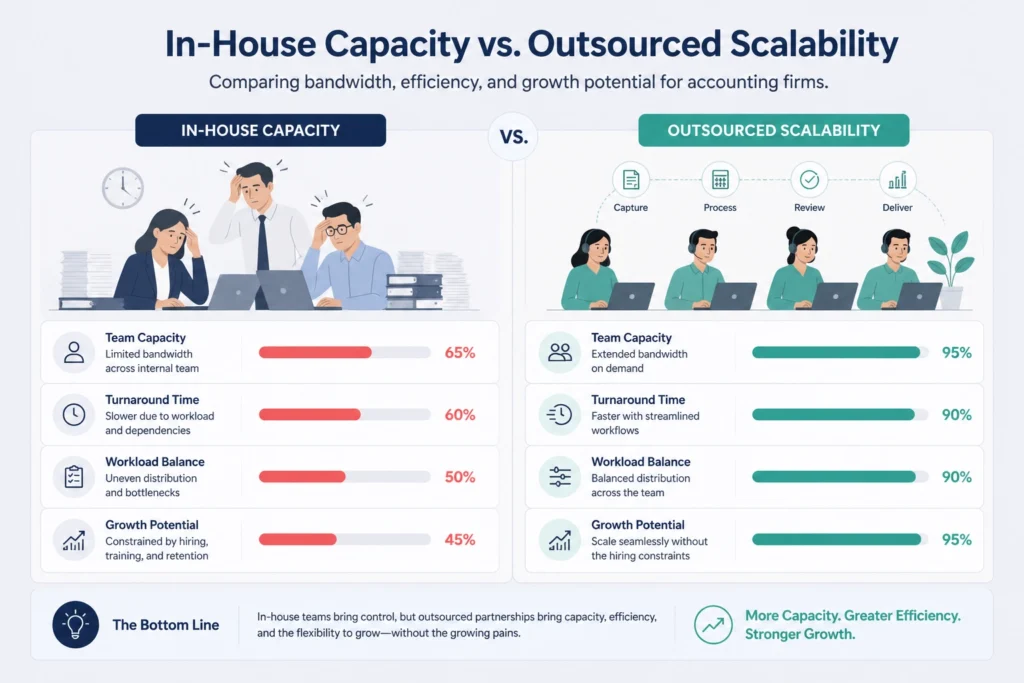
Most firms don’t actually have a demand problem; they have a production problem where the front end sells the work but the back end cannot keep up. When senior people are forced to perform tasks that a graduate could handle with a tight checklist, the entire division jams up every quarter, which is why SMSF audit outsourcing is the key to solving the production bottleneck that frequently halts growth in modern accounting practices. This reliance on senior staff to hold fragile processes together prevents scalability and leads to patchy audit support that frequently gets kicked back during the review phase.
That inefficiency ultimately kills your margins and burns out your best people. A senior accountant did not sign up to spend peak-season hours downloading broker statements, renaming PDFs, fixing BGL coding, or chasing unsigned minutes. When the senior team is dragged into admin and file cleanup that should have been resolved three steps earlier, you lose the ability to focus on high-value advisory. Implementing professional back-office support ensures your senior specialists are liberated from tedious data entry, allowing your firm to scale effectively without the constant risk of operational burnout.
SMSF audit outsourcing to solve the Australian talent shortage
That line isn’t theory. It’s what firm owners are dealing with right now. You can advertise for months. You can pay more. You can lower the brief and hope someone grows into the role. Still risky. Still slow. Still expensive once you factor in recruiter fees, training time, rework, manager oversight, sick leave, annual leave, and the chance they leave right before deadlines.
So no, the answer usually isn’t “just hire.”
The better move is to fix the way the work moves.
The supply-demand math doesn’t work for in-house teams
This is where the market data starts to matter.
There are now over 661,000 SMSFs in Australia, and by late 2025 the net growth rate had pushed to record highs of roughly 33,000 new funds a year.
Now look at the other side of the ledger.
ASIC-registered SMSF auditors have dropped from more than 6,500 in 2016 to just 3,762 by early 2026. On top of that, ASIC is still clearing out non-compliant or inactive auditors, with 28 regulatory actions in the first half of FY26 alone.
That’s not a temporary staffing issue. That’s a structural squeeze.
More funds. More files. More audit pressure. Fewer qualified people available to sign off on the work.
So when firms say they have a hiring problem, that’s only part of it. The real issue is bigger. The vol-ume keeps rising while the qualified pool keeps shrinking. That means the production problem gets worse even if your internal team stays steady.
This is exactly why in-house only models start to crack under growth. You are asking a tighter labour pool to absorb a larger volume of technical work every year. The math does not work.
SMSF audit outsourcing fixes the bottleneck where it actually sits
Most firms hit the same wall. Fund numbers rise. Lodgement deadlines get closer. Review queues get longer. Client emails pile up. People start working weekends. Then a partner looks at the pipeline and says the firm needs more staff.
Maybe. Maybe not.
A lot of the time, you don’t need more senior experts. You need fewer hands touching routine prep. You need cleaner files. You need work built in the right order. You need someone owning the ugly middle section between bookkeeping and audit completion.
That’s where SMSF audit outsourcing earns its keep.
Not because it sounds efficient on a website. Because it takes a messy, stop-start workflow and gives it shape. Files get prepared properly. Support gets checked earlier. Exceptions get flagged sooner. Re-viewers stop wasting their day on admin archaeology.
At BlueCrest, we see the same pain points over and over:
- Senior reviewers fixing file structure
- Managers chasing missing evidence
- Admin teams sending half-complete document requests
- Auditors raising queries that should’ve been prevented
- Firms delaying new client onboarding because existing jobs already feel too heavy That’s not a hiring problem on its own. That’s a workflow stack problem.
What actually goes wrong in BGL360 and Class when the process is loose
Let’s talk about the part most blog posts skip.
Manual work inside BGL360 and Class is where a lot of firms bleed time. Not because the software is bad. Because the process around it is sloppy.
You’ve seen it. A bank feed comes through but the transaction coding isn’t reviewed properly. Corporate action entries need checking. Pension drawings have been treated inconsistently across periods. Contribution allocations don’t line up cleanly with source support. Income gets posted, but the evidence pack sitting behind it is thin. Asset valuations sit in a separate folder with useless file names. This is where SMSF audit outsourcing steps in to fix the process, ensuring all data and documentation are audit-ready before they reach your senior team.
The trust deed update isn’t where anyone expects it to be. One person uses one naming method. An-other does their own thing. Review becomes slow because the file has no rhythm.
Then the senior accountant opens the fund and loses 40 minutes before even starting the real review.
Class can look clean on the surface and still hide a mess underneath. BGL360 can process volume fast, but if the underlying support trail is weak, speed means nothing. You still end up with workpapers that don’t tie neatly. You still get auditor queries. You still pay for the chaos.
That’s why good SMSF audit outsourcing isn’t just data entry. It’s controlled file prep.
It’s knowing what evidence matters. It’s knowing which transactions need extra care. It’s knowing that one missing rollover statement or one bad pension classification can create three rounds of pointless follow-up later.
Also Read: Class Super vs BGL Simple Fund 360
The margin leak is senior time. Nothing else comes close.
Founders sometimes look at outsourcing and ask one question first. What’s the per-fund cost? Fair question. Wrong first question.
The real question is what your current process costs in hidden senior time.
Say a senior accountant is costing the firm well north of base salary once you add super, software, leave, management overhead, desk cost, QA time, and the general drag of running a local team. Call it $90 to $130 an hour in real internal cost depending on the setup. In some firms it’s more.
Now look at what they’re doing during busy periods:
- reviewing files that weren’t prepared properly
- recoding transactions that should’ve been resolved earlier
- chasing contract notes
- cross-checking pension documents
- cleaning up workpaper references
- answering auditor questions caused by weak file assembly
- jumping into jobs late because no one trusts the prep layer Five hours gone. Six hours gone. On one fund.
Spread that across 120 funds. The numbers get ugly fast.
And that’s before you count the opportunity cost. Those are hours not spent on client calls, tax plan-ning, advisory, pricing, process improvement, or bringing in better work. High-cost people doing low-value cleanup is one of the biggest margin leaks in an SMSF practice.
You don’t fix that with motivational speeches. You fix it by changing the delivery model.
The ugly part of audit prep is where firms lose control
Here’s the line that matters, and it stays true in every firm size bracket: Audit readiness is often the biggest friction point between an accountant and an auditor. By implementing SMSF audit outsourcing, you ensure that if the workpapers are incomplete or the evidence is messy, the audit doesn’t drag on, costs don’t spike, and the relationship never sours.
That’s the choke point.
Not the tax return. Not the client meeting. Not the billing. The file handoff.
A fund can look “done” internally and still be nowhere near ready for audit. Missing lease docs. No signed trustee minutes. Market valuation support not current. Pension paperwork incomplete. Corpo-rate actions not evidenced clearly. LRBA documents split across inboxes. Related-party lease support buried in old folders. Nothing referenced properly. The trial balance might be done. The audit file still isn’t.
Then everyone starts blaming everyone else.
The accountant blames the client for missing records. The auditor blames the accountant for weak workpapers. The manager blames the team for poor follow-through. The client gets annoyed because fees climb and the fund takes too long.
This is exactly why the prep layer matters so much.
A proper prep process checks the file before it hits the auditor’s desk. It doesn’t wait for the auditor to find the holes.
And one piece of that process needs to be explicit every single time: Referencing: Cross-referencing the financial statements to the source documents so the auditor can move quickly.
Simple sentence. Huge impact.
Independence pressure in 2026 isn’t getting lighter
Some firms still treat independence as a box-ticking exercise. That’s a mistake.
The pressure around auditor independence, role separation, and documentation is real. You can read the source material yourself in APES 110. The issue isn’t just knowing the rules exist. The issue is what happens operationally when your team is stretched and boundaries get blurred.
That’s where firms get exposed.
One person helps prepare part of the file, then gets too close to review support. Reciprocal audit arrangements start looking thin. Internal notes aren’t clear enough. Segregation exists on paper but not in the actual day-to-day workflow. The file history tells a different story from the policy manual.
In 2026, you can’t be loose on this.
You need a process that shows separation, not just claims it. You need production support that sits in the right lane. You need reviewers focused on review. You need audit prep done cleanly without crossing lines that create independence headaches later.
That’s another reason firms use SMSF audit outsourcing. It helps define the boundary between prep work and final oversight. It creates clearer ownership. It reduces the chance that a stressed local team starts cutting corners because the deadline is too close.
Standardisation matters, but don’t make it robotic
You do need standard file assembly. You do need consistent naming. You do need document request lists. You do need review notes handled properly.
But firms mess this up when they create “process” that looks neat in a slide deck and falls apart in live jobs.
Real process needs to deal with annoying edge cases. Partial commutations. Property funds with stale valuations. Contribution timing issues. Member balance anomalies. Corporate actions that don’t map cleanly. Pension reset documents sitting outside the fund software. Old trust deed changes no one can find quickly. Auditor preferences that differ slightly from file to file.
That’s why a good support model can’t just be generic admin. It needs SMSF-specific judgment in the prep stage.
What good outsourced SMSF prep actually looks like in prac-tice
Not fancy language. Just solid execution. A good prep team will:
Spot missing support before review starts. Chase the right documents, not random ones. Reconcile balances back to source records.
Leave a trail a reviewer can follow fast.
Build a file that an auditor can move through without stopping every two minutes.
Work directly inside auditor software like Cloudoffis, MyWorkpapers, Evolv, or Online SMSF Audit without creating another layer of file chaos.
Handle the technical heavy lifting, including SIS Act compliance testing and cross-referencing, so the auditor can stay focused on professional judgment and sign-off.
Raise exceptions early when the evidence doesn’t stack up. Keep the work moving even when volume spikes.
That’s the difference.
If you already outsource parts of your SMSF accounting process, adding structured audit prep sup-port usually makes the whole chain tighter. Less duplication. Less cleanup. Less rework between ac-counting and audit.
Want a blunt answer on whether outsourcing is worth it?
Ask this instead.
What happens in your firm when 40 more funds land over the next six months?
Do you have spare senior capacity?
Can your current team handle the file prep without late nights? Will the auditors get cleaner files, or just more of the same mess?
Can you absorb staff leave, turnover, and deadline bunching without service quality dropping? Most founders already know the answer.
They just don’t always want to say it out loud.
If growth depends on one or two senior specialists holding the whole process together, the setup is fragile. If every extra fund creates extra stress, the setup is fragile. If the audit file quality changes depending on who touched it that week, the setup is fragile.
This is where outsourcing becomes practical, not theoretical.
Our SMSF audit support services are built for this exact pressure point. We act as a dedicated back-office team for registered auditors. We handle the technical heavy lifting in the prep layer, including SIS Act compliance testing, workpaper support, and cross-referencing, so auditors can spend their time where it actually matters: professional judgment and sign-off.
When you outsource SMSF audit preparation, you turn a chaotic, document-heavy process into a streamlined production line. Outsource SMSF audit tasks and administrative processing to a trusted B2B partner. This is the only way to build a truly scalable, profitable, and compliant SMSF practice in 2026.
That sentence is blunt because the market now demands blunt thinking.

One last thing
Firms say they want growth. Most actually want growth without mess. Fair call.
You won’t get that by letting senior accountants drown in admin and hoping software alone will save you. You won’t get it by hiring reactively every time the backlog hurts. You won’t get it by pretending independence pressure is someone else’s problem.
You get it by building a workflow that can carry volume.
You get it by protecting your senior team from low-value grind.
You get it by fixing audit readiness before the auditor gets dragged into a bad file.
If you are ready to stop chasing documents and start growing your firm, it’s time to rethink your workflow. Focus on your clients, and let us handle the technical heavy lifting through SMSF audit outsourcing. A proper B2B support partner works inside controlled systems, follows access rules, limits who can see what, and uses defined workflows instead of random email chains and desktop file dumping. The point is simple. Keep the data contained. Keep access tight. Keep an audit trail. If a provider can’t explain their controls in plain English, don’t use them.