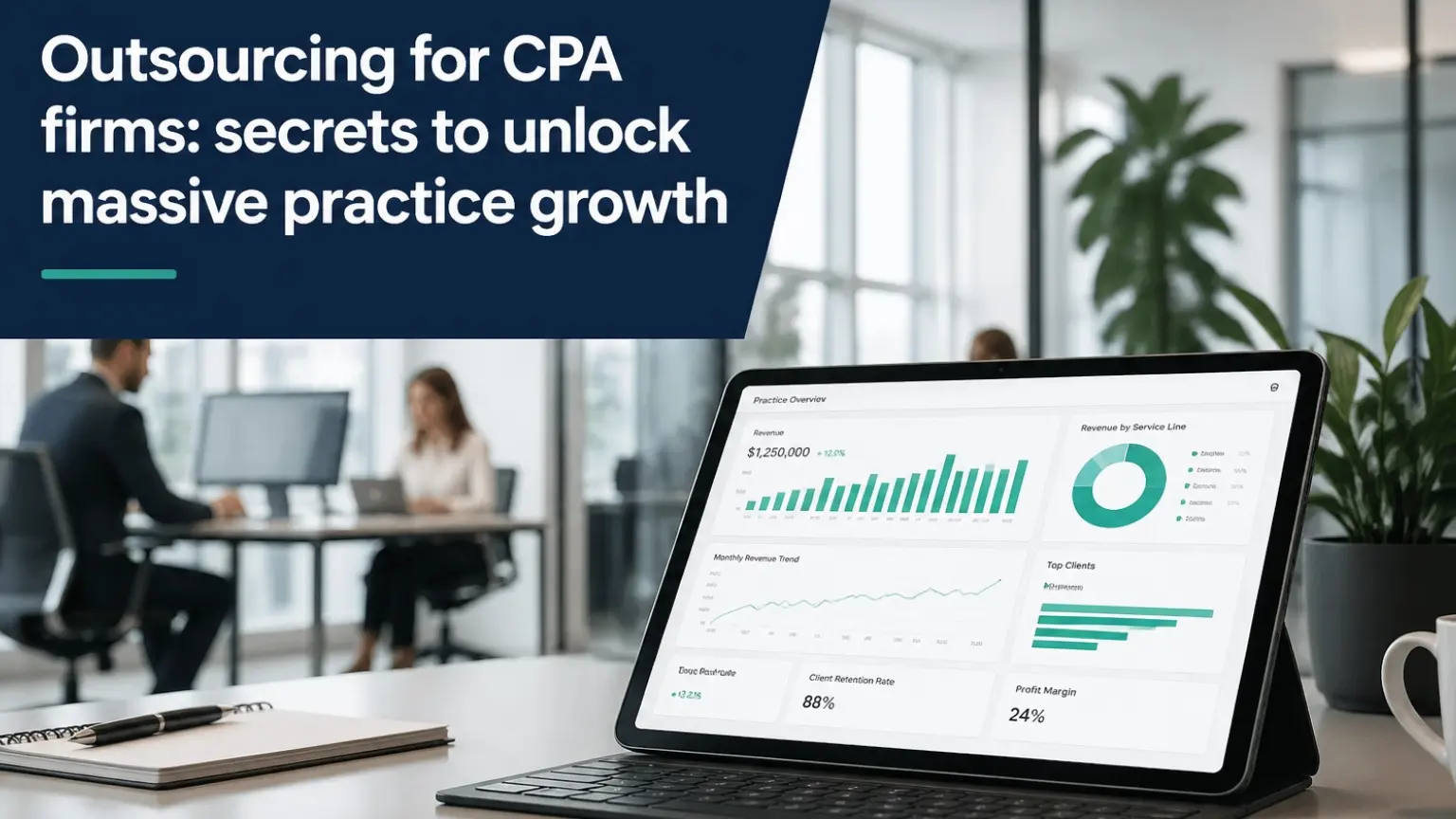
Are your senior accountants still buried in file work, hiring for the same role again, and watching weekends disappear because of BAS or review queues? That’s usually where the conversation about outsourcing for CPA firms starts. It is not about a grand strategy deck or a trend report, but just a founder looking at the calendar and the team and thinking, “We can’t keep running the firm like this.
The firms doing it well aren’t trying to be clever; they’re trying to get real capacity back. This is the kind of capacity that stops partners from doing prep work, stops managers from drowning in reviews, and stops your firm from feeling one resignation away from chaos.
At BlueCrest, we work with Australian accountants, bookkeepers, and SMSF professionals every day and see the same pattern over and over. Demand isn’t the issue, and clients aren’t the issue, but the bottleneck is usually delivery capacity. There’s work coming in without enough clean hands behind it, and when that happens, the founder becomes the overflow tank, which gets old fast.
How much does it cost to outsource accounting?
Let’s start with the question everyone asks first.
If you hire locally, a junior-to-mid-level accountant in Australia will often cost somewhere between
$80,000 and $120,000 a year, once you include salary, super, leave, recruitment fees, onboarding, software, office overhead, and the time it takes to manage them properly.
If you build offshore capacity with accountants who already work on Australian files, the range is usually closer to $35,000 to $55,000 per seat. That depends on experience, file complexity, software knowledge, and how much review support you need.
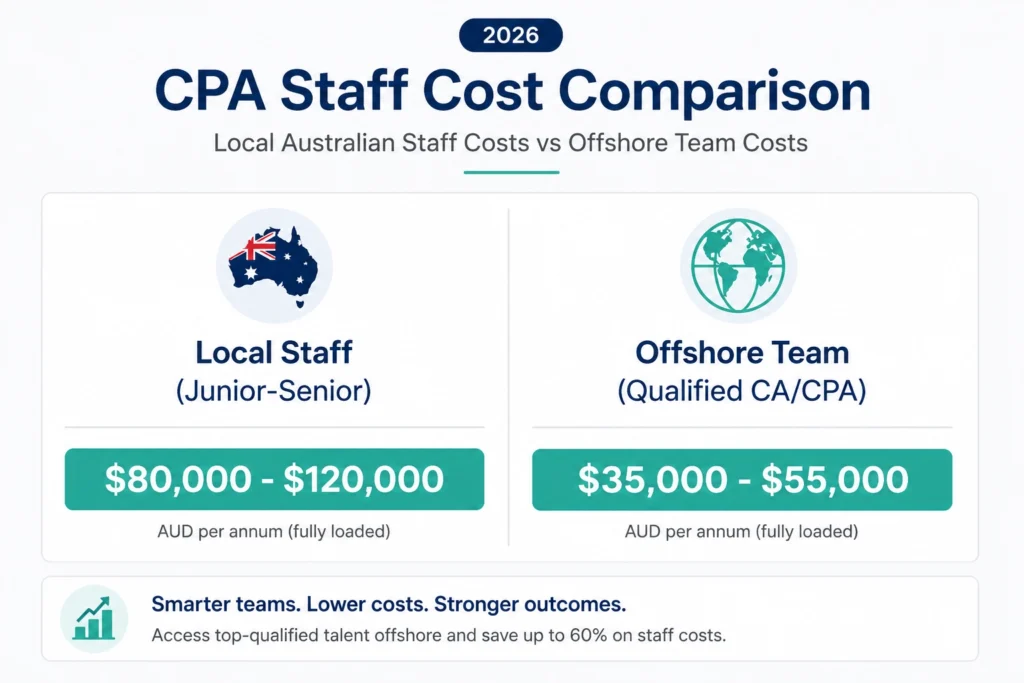
Here’s the simple comparison:
| Cost Area | Local hire | Offshore Team Member |
|---|---|---|
| Base annual cost | $80k-$120k | $35k-$55k |
| Recruitment cost | High | Lower |
| Time to hire | Often slow | Usually faster |
| Office overhead | Usually yes | Often no |
| Flexibility in scale | Lower | Higher |
| Peak-season support | Harder | Easier |
Yes, the savings matter. Of course it does. But that’s not the whole story, and most founders know it.
Why outsourcing is effective isn’t just about trimming costs. In reality, it is about getting your firm out of the cycle where senior people keep doing low-level work because nobody else has the bandwidth. Furthermore, it means not spending Sunday night fixing a BAS. Ultimately, you avoid training a junior for three months only to watch them leave just when they’ve stopped asking where things are in Xero.
That’s why elite firms do it. Capacity first. Cost second.
Why Australian firms outsource accounting in the first place
Nobody does this because they feel like adding complexity for fun. They do it because the current setup stops working.
That’s why accounting outsourcing in Australia keeps growing. Local hiring is slow. Good people are expensive. Great people are even harder to keep. Compliance work keeps coming whether your team is ready or not. Clients still expect fast turnaround. And founders get tired of being the last person in the chain who has to fix everything.
You’ve probably seen some version of this:
- A good client says yes, but the team is already full
- A senior accountant spends half the week on cleanup work
- A manager gets stuck reviewing jobs that should’ve been right before they hit review
- The founder ends up spending nights untangling workflow problems instead of running the business
That’s the real driver. Not hype. Pressure.
A lot of firms start with bookkeeping services, Tax Preparation, or SMSF Compliance. Those areas usually carry repeat work, deadline pressure, and enough process structure to make a solid first step.
How outsourcing for CPA firms actually works when it’s done well
Here’s the blunt version.
Bad outsourcing creates more review work. Good outsourcing takes work off your plate. The difference is almost never the sales pitch. It’s the setup.
If you want outsourcing for CPA firms to work, a few things need to be locked in early.
Clear scope
Be specific. Consider which work moves and which tasks stay local. Additionally, define who reviews the work and clarify what counts as complete. If nobody can answer that cleanly, the handoff will wobble.
Documented process
If your process lives in someone’s head, it’s not a process. Record Loom videos. Build checklists. Save examples. Write down review rules. Keep it plain.
Access and controls
Use role-based access. Lock down permissions. Keep activity visible. Don’t rely on good intentions alone.
Review structure
Decide who prepares, who checks, who escalates, and who signs off. That’s how quality stays predictable.
Fast feedback
This matters more than people think. Teams improve quickly when feedback is clear and prompt. They don’t improve from vague comments dropped in once a fortnight.
That’s where strong accounting outsourcing companies in Australia stand out. They don’t just supply hands. They work inside a structure.
What software do CPA firms use with offshore teams?
This part should be easy.
If you’re asking what software CPA firms use with offshore teams, the answer is usually the same stack you already use in-house.
For most Australian firms, that means:
- Xero for bookkeeping, reconciliations, reporting, and year-end support
- MYOB for business accounting and payroll-heavy files
- HandiSoft for tax workflows and practice management
- BGL 360 for SMSF administration and compliance support
- Class Super for SMSF processing, reporting, and workpapers
This matters because nobody wants to waste three weeks teaching a provider how files move through your practice. If the team already understands Xero workpapers, MYOB structure, HandiSoft workflows, BGL 360 fund processing, and Class Super reporting, onboarding gets easier fast.
At BlueCrest, that’s the software stack we work with every day. It makes a difference.
Why CPA firms are outsourcing to India
Simple reason. Talent and scale.
India has a deep pool of trained accountants, and many of them already work on Australian files. That’s why firms looking at outsourcing Australian accounting service options often end up there.
The better teams already have experience with:
- GST and BAS processing
- workpaper preparation
- financial statement support
- payroll checks and reconciliations
- SMSF administration support
- year-end file clean-up
- tax return preparation support
That matters when you’re choosing outsourcing accountants, Australian firms can actually rely on.
There’s also the time zone advantage. Work handed over late in the Australian day can often be progressed overnight. Used properly, that shortens the queue and gives your local team breathing room.
If you want a broader view, read an offshore accounting guide before you choose a provider. It’ll save you from asking the wrong questions too late.
Why white-label outsourcing is a strategic choice
This is the part founders care about more than they admit. “Will this mess with the client relationship?”
Fair question.
That’s why the white-label accounting services model matters. It’s not a cosmetic feature. It’s a strategic choice.
Your clients still deal with your firm directly. Meanwhile, the local team stays front-facing. Furthermore, your standards stay in place while the outsourced team works quietly in the background using your process, templates, and review rules.
That gives you a cleaner setup:
- You keep the client relationship
- You keep control of quality
- You protect brand consistency
- You add capacity without creating a clunky client experience
That’s one reason major CPA firms use white-label support. It lets them scale output without turning delivery into a circus.
Security, Data Privacy, and why this cannot be an afterthought
Every founder gets to this question sooner or later. Good. You should.
You’re handing over tax files, payroll data, identity documents, SMSF records, and financial information. Nobody sensible should be casual about that.
When you’re assessing outsourcing for CPA firms, look for the practical stuff:
- strict data privacy protocols across systems, devices, and file handling
- adherence to the Australian Privacy Principles
- bank-grade security for data storage, access, and transfer
- multi-factor authentication
- restricted downloads and device controls
- audit trails
- documented incident handling
- clear user permissions
Security and data privacy matter because one weak point can become a very expensive problem. You want a provider that can explain how they protect client data in plain English, not bury it under polished wording.
The Australian Taxation Office also gives practical guidance on protecting taxpayer information and secure digital practices. Read it. Ask hard questions. If a provider can’t explain privacy handling, access control, and file security clearly, walk away.
What work should you outsource first?
Don’t start with the ugliest job in the office.
Start with repeatable work. Clear steps. Clear review path. Easy to measure. That usually means:
- bank reconciliations
- accounts payable processing
- accounts receivable support
- BAS preparation support
- standard business tax return prep
- year-end workpapers
- SMSF transaction coding and admin support
- payroll processing support for recurring payroll cycles
That’s often where the best outsourcing companies Australia firms use can prove themselves. You can test turnaround, quality, communication, and review effort before you widen the scope.
A practical rollout plan for outsourcing accounting services
Keep this part simple. Fancy rollout plans look nice in a meeting and then fall apart in real life.
Step 1: Analyse the bottleneck
Find the actual pressure point. Tax prep backlog. Cleanup work. SMSF administration. Payroll delays. Review congestion.
Step 2: Verify what can move
Don’t send everything offshore on day one. Start with repeatable prep work. Keep judgment-heavy advisory work local.
Step 3: Document your standard
Create checklists. Save examples. Define naming rules. Set review points. Spell out exceptions.
Step 4: Reconcile access and security
Set permissions across Xero, MYOB, HandiSoft, BGL 360, and Class Super. Use MFA. Restrict access by role.
Step 5: Start with a pilot
Pick a small batch of files. Measure rework, timing, communication, and review load.
Step 6: Review weekly
Fix small issues early. Don’t let them turn into normal behaviour.
Step 7: Expand when the workflow is steady
Then move into broader compliance work with confidence.
That’s how firms make outsourcing accounting services work without turning it into another prob- lem to manage.
Common mistakes firms make with outsourced accounting
The same mistakes show up all the time.
They outsource a messy process
If your internal workflow is chaotic, outsourcing just spreads the chaos faster.
They give weak instructions
A smart team still needs clear direction. “Can you sort this out?” is not a process.
They expect instant perfection
The first few weeks are usually a calibration. That’s normal.
They buy on price alone
Cheap gets expensive quickly when rework starts stacking up.
They ignore culture fit
If the offshore team doesn’t understand your standards and review style, quality drops. You see this especially fast in audit outsourcing and other high-compliance work.
Ready to grow without breaking your team?
Here’s the real talk version.
Firms don’t outsource because it sounds impressive. They outsource because they’re sick of bottlenecks, late nights, patchy hiring, and watching good local staff burn out on work they shouldn’t be doing.
Done properly, outsourcing for CPA firms gives you breathing room. Better capacity. Cleaner turn- around. Less founder cleanup. Stronger margins. A more stable team.
At BlueCrest, we help firms build secure, white-label support across bookkeeping, tax, payroll, and SMSF workflows. Our experts know the software and also understand the deadlines. Ultimately, we know exactly what usually breaks first in the production line.
If your firm is growing and the backend is starting to creak, fix that first. Contact BlueCrest today if you want to talk through a practical white-label offshore model for your firm.