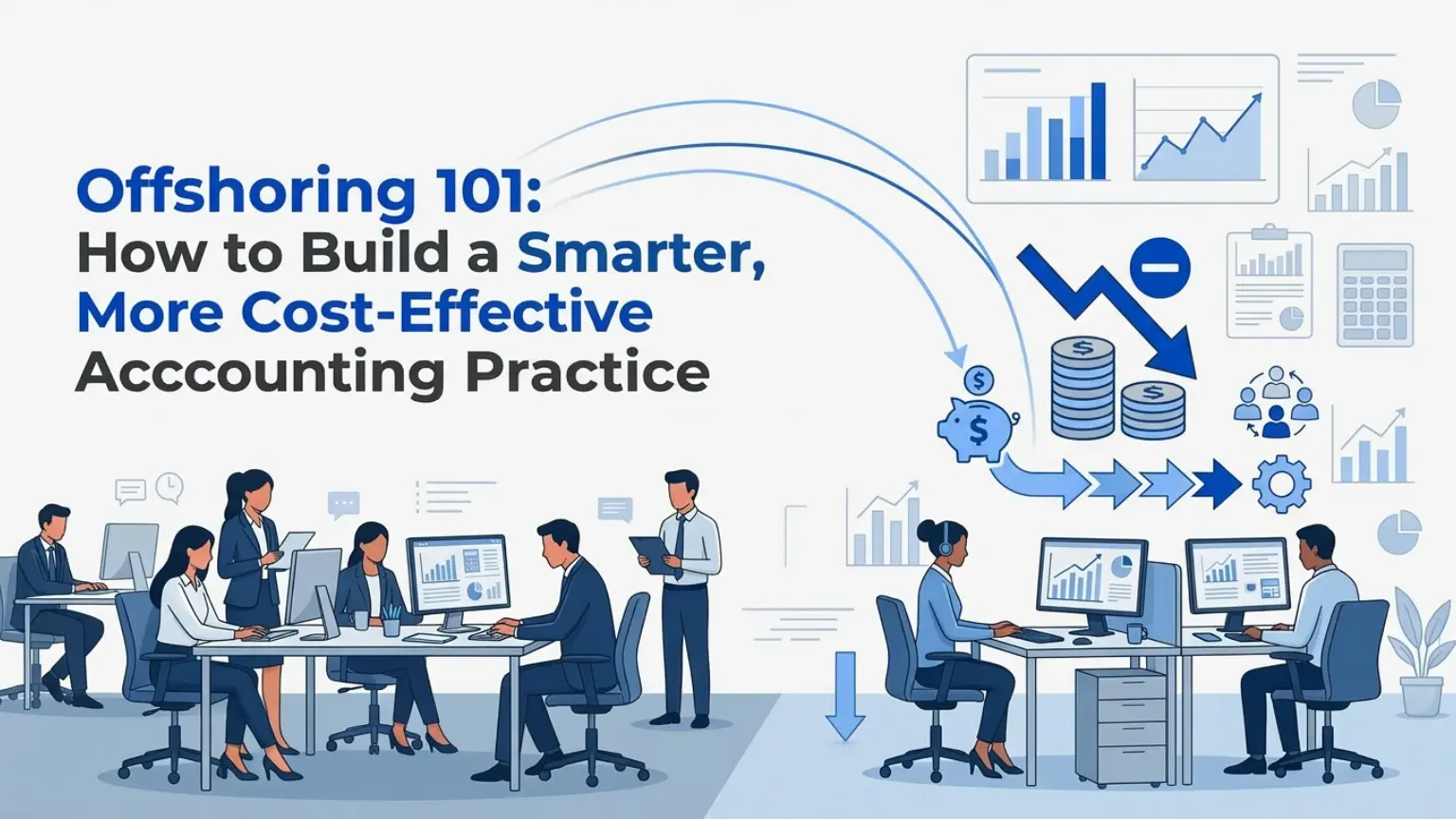
Australian bookkeeping practices, tax agents and SMSF accountants are hitting a wall. There is too much compliance work, not enough staff, and shrinking margins.
Offshoring routine processing work to qualified offshore accounting teams helps Australian practices grow their client base without burning out their people or increasing costs.
What Is Accounting Offshoring and How Is It Different from Regular Outsourcing?
Accounting offshoring means engaging qualified accounting professionals in another country to handle specific tasks inside your practice. These countries typically include countries like India, the Philippines or Sri Lanka. Unlike general outsourcing, offshoring involves a cross-border arrangement. The offshore team works directly within your systems and processes. However, many firms discover that outsourcing accounting in Australia requires working with providers who understand local compliance requirements.
Three years ago, a bookkeeper in Brisbane told us she was working 70-hour weeks once the quarter ends. Not because she was bad at her job. She just had more work than one person could do, couldn’t find decent local staff and had clients expecting turnaround times that assumed she had a team behind her.
She now runs a practice twice the size. Works fewer hours. Takes August off.
The difference wasn’t a magic system or a business coach. She offshores her processing work to our team in India who know Xero inside out and have been doing Australian BAS and bookkeeping work for years.
Common tasks offshored by Australian accounting practices include:
- BAS and IAS preparation
- Individual, company and trust tax return processing
- SMSF transaction reconciliation and annual compliance work
- Payroll processing
- Bank reconciliations
- AP/AR and management reporting
What Are the Real Benefits of Offshoring for Australian Bookkeepers and Accountants?
For Australian accounting practices, offshoring delivers five measurable advantages:
- lower cost per job,
- access to qualified accounting talent trained in Australian tax law,
- capacity to absorb peak-season volume,
- faster overnight turnaround on preparation work, and
- the ability to grow a client base without proportionally growing fixed overhead.
Lower Cost Per Job — And It Compounds: An experienced accountant in Sydney or Melbourne — salary, super, leave loading, and overhead — can cost a practice $90,000 to $110,000 a year. Offshore accounting professionals with genuine Australian tax knowledge cost 60–70% less. For a practice processing 300+ returns a year, that differential is material. Many practices also realise that accounting outsourcing helps Australian firms grow by improving efficiency while reducing operational costs.
Access to Talent That’s Actually Available: Finding a good bookkeeper or tax accountant in Australia right now is genuinely hard. Offshore talent pools — particularly in India — include CA and CPA-qualified professionals. Many are trained in ATO systems, Australian compliance frameworks, and the software Australian practices use. That specialist availability simply doesn’t exist in most local markets.
Peak Season Capacity Without Panic Hiring: The March–May individual tax return surge and the October BAS deadline are predictable pressure points. Under the Australian Privacy Act 1988, specifically APP 8, your practice is also accountable for how client data is handled offshore.
Overnight Turnaround on Preparation Work: With offshore staff working while your Australian team is offline, reconciliations, return preparation, and workpaper compilation can be completed overnight. Your local accountants arrive each morning to review-ready files rather than starting from scratch.
Expert Tip: The cost benefit only holds if quality is there. A cheap offshore team that generates rework isn’t saving you money — it’s just moving where your time goes. Quality comes from choosing the right partner, documenting your workflows, and having a real review step before anything goes out the door.
What Work Should You Offshore vs. Keep In-House?
The practical rule is straightforward: offshore anything that can be described in a step-by-step process document and doesn’t require a direct client conversation. Keep onshore anything that requires professional judgement, client relationships, or your TPB registration sign-off.
Here’s how that breaks down by practice type:
For Bookkeepers
Offshore: bank reconciliations, accounts payable data entry, payroll runs, STP submissions, Xero/MYOB file maintenance
Keep onshore: client communication, advisory conversations, final review, ATO correspondence
For Tax Accountants:
Offshore: ITR preparation (individual, company, trust, partnership), financial statement prep, depreciation schedules, FBT return preparation, pre-fill review
Keep onshore: complex tax planning, client strategy sessions, review and lodgement, ATO dispute handling
For SMSF Accountants:
Offshore: Many firms successfully outsource SMSF accounting tasks to offshore teams to improve efficiency and manage workload. These tasks typically include transaction coding, investment reconciliation, pension calculations, minimum drawdown schedules, contribution cap monitoring, and audit file preparation.
Keep onshore: trustee advice, SIS Act compliance review, investment strategy documentation, and member communications
How Much Does Offshore Accounting Support Actually Cost Australian Practices?
Australian practices working with offshore accounting partners typically report cost savings of 60–70% compared to equivalent local hires, with most practices recovering their investment within the first tax season. The exact cost depends on the partner, the role level, and the volume of work — but the gap between Australian and offshore market rates is substantial enough to materially change the economics of a small practice.
The numbers matter here. A mid-level tax accountant in Australia costs roughly $85,000–$110,000 all-in annually. In comparison, firms using offshore accounting support for Australian practices can access experienced accountants with real Australian compliance knowledge at a fraction of that cost—without sacrificing output quality when the engagement is set up properly.
What practices often don’t account for is the indirect cost of not offshoring. Turning away clients at peak season, burning out good staff, or spending $15,000 on a recruitment process for a role you can’t fill — these are real costs that don’t show up on a salary line.
How Do You Choose the Right Offshore Accounting Partner for an Australian Practice?
Evaluate five things before committing: depth of Australian tax knowledge, hands-on experience with the software your practice uses, data security compliance with the Australian Privacy Act, an internal quality review process, and willingness to do a structured pilot before full engagement. How a partner handles the pilot predicts how they’ll handle the relationship.
- Australian Tax Knowledge — Test It, Don’t Assume It: Your offshore team needs to know how the ATO works in practice — not just accounting theory. You can ask specific questions regarding Division 7A, CGT concessions, SIS Act requirements for SMSFs, STP obligations and BAS preparation. If the answers are vague or generic, keep looking.
- Software Experience That’s Specific and Verifiable: There’s a real difference between a team that has worked in Xero with Australian clients for three years and one that completed an online course last month. Same goes for BGL360 and Simple Fund 360 for SMSF work, HandiSoft and XPM for tax. Try looking for specifics like which platforms, how long, at what volume.
- Privacy Act Compliance Is Non-Negotiable: Under Australian Privacy Principle 8 (APP 8), your practice remains accountable for how client data is handled offshore. Your offshore partner agreement must include data handling obligations that mirror the APPs. This should also be addressed in your client engagement letters — clients have a right to know their data may be processed offshore.
- Internal Review Before Work Reaches You: The best offshore teams don’t send you first-pass drafts. They have their own quality review step built into their workflow. If there’s no internal review process, you become the quality filter — and that largely defeats the purpose.
- Run a Pilot First: Any offshore partner worth working with will agree to a structured trial — 20 to 30 jobs over a defined period — before you sign anything ongoing. Watch turnaround times. Count errors. Notice how they communicate when something isn’t clear. The pilot tells you everything the sales process won’t.
Does Offshoring Create Any Legal or Compliance Risk for Registered Tax Agents?
No — provided your review and lodgement process remains onshore and under your professional supervision. Your TPB registration obligations don’t change based on who prepares the underlying work. What changes is that your review process needs to be real, documented, and consistently applied.
This comes up every time offshoring is discussed in tax agent circles, so it’s worth being direct about it.
You remain fully responsible for everything lodged under your registration. An offshore team preparing a return doesn’t shift any of your obligations under Tax Practitioners Board guidelines. However, that is exactly how the model is designed to work — offshore teams handle the preparation, while you review and lodge the return, ensuring the professional responsibility remains with the registered agent. This structure is the same whether the preparation is done by an offshore team, a graduate accountant in your office, or a contractor working locally.
Under the Australian Privacy Act 1988, specifically APP 8, your practice is also accountable for how client data is handled offshore. Data handling obligations must be documented in your offshore partner agreement, and your client engagement letters should disclose that data may be processed offshore.
What Are the Honest Downsides of Offshoring Your Accounting Work?
Offshoring doesn’t fix a disorganised practice — it amplifies whatever systems you already have. Undocumented workflows, inconsistent file standards and unclear quality expectations will create more problems offshore than they do onshore. The other real limitation is real-time communication: the time zone gap means you can’t have a quick back-and-forth during the Australian business day.
Getting the setup right takes time. Even experienced offshore accountants need a few weeks to learn your specific processes, your client base, and your preferences. The first month typically involves more back-and-forth than the sixth. That’s normal — budget for it rather than expecting instant output.
The practices that struggle most with offshoring are usually the ones that start during tax season. They are often too busy to onboard properly, and when offshore bookkeeping support is introduced without clear processes, the offshore team ends up learning under pressure, which quickly leads to frustration. The practices that do it well start in the quieter months — January through March — document their processes, run a proper pilot, and enter the next tax season with a team that already understands how their firm operates.
Pro-Tip: The Best Time to Set This Up Is “Right Now”
If you’re reading this and thinking “I’ll look into this after tax season” — that’s the exact thinking that keeps practices stuck at the same capacity year after year.
The practices growing fastest right now aren’t working harder. They’ve documented their workflows, found a partner whose team knows Australian tax, and built an offshore model that runs quietly in the background while they focus on the work that actually requires them.
Starting in the quiet months means arriving at your next peak season with a tested, functioning team rather than scrambling to set something up while you’re already underwater.
BlueCrest Professional Accounting Solutions provides offshore accounting support for Australian bookkeepers, tax accountants and SMSF practices. Our teams are trained in Australian tax law, ATO compliance systems and the platforms your firm already uses. Book a consultation to explore how our offshore accounting team can support your firm’s growth and efficiency.